|
December
New Orleans Show.
Los Angeles Times - Dec 4,
1910
Automobile and Sports
December 7 -- Louis Prima is Born 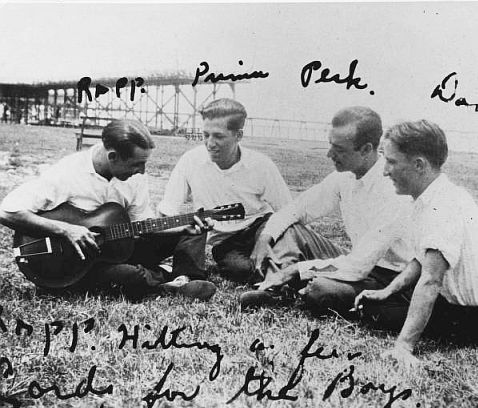 Louis Leo Prima Louis Leo Prima (1910--1978) Born in the French Quarter of Sicilian immigrants Angelina and
Anthony Prima, Louis played at the Shim Sham Club four decades later. A violinist (until 15) turned trumpeter (when
he picked up older brother Leon's horn) as a young man played with Irving Fazola, with his brother Leon's band, and in the
house band at the Saenger Theater in New Orleans (1931). In this 1924 photograph (above we see
(left to right) Leon Roppolo (playing the quitar), Louis Prima, Peck Kelly, Don (unknown). The Inscription reads: "Ropp
hitting a few cords for the boys." The image was likely shot at the New Orleans lakefront. From the photo collection
of Dr. Edmond Souchon. During 1930s Prima worked with Red Nichols, before forming a seven-piece jazz
band called "Louis Prima's New Orleans Gang" which he formed in New York City in 1934 where he played with
fellow New Orleans musicians Eddie Miller (tenor sax and clarinet) and George Brunies (trombone). Prima composed "Sing
Sing Sing" (now in the Grammy Hall of Fame) in 1936 before it became one of Benny Goodman's most popular swing era tune.
Twenty years later Prima recorded "Jump, Jive and Wail" (1956). This 1924 Photograph of (left to right) Leon Roppolo (playing the
quitar), Louis Prima, Peck Kelly, Don (unknown). The Inscription reads: "Ropp hitting a few cords for the boys."
The image was likely shotat the New Orleans lakefront. From the photo collection of Dr. Edmond Souchon http://louisdl.louislibraries.org/u?/JAZ,1713 Louis Leo Prima Born in the French Quarter
musician (December 7, 1910) -- of Sicilian immigrants Angelina and Anthony Prima played here four decades later.
Violinist (until 15) turned trumpeter (picked up older brother Leon's) as a young man played trumpet with Irving
Fazola, with his brother Leon's band, in the house band at the Saenger Theater (1931). early 30s Prima worked with Red
Nichols, before forming seven-piece jazz band called 'Louis Prima's New Orleans Gang', . moved to New York
in 1934 -- played with fellow New Orleans musicians Eddie Miller (tenor sax and clarinet) and George Brunies (trombone)
 http://louisdl.louislibraries.org/u?/JAZ,454
Leon Prima (1907-1985) older brother of Louis Prima -- trained
as pianist but trumpet player/band leader ran
the Shim Sham Club (229 Bourbon) and the 500 Club (441 Bourbon?) whose
house band was led by Sam Butera - before Butera joined Louis Prima's band in Las Vegas in 1954). As a young man played with Leon Roppolo, Ray Bauduc, Jack Teagarden,
Peck Kelley's Bad Boys (1925-27) in Texas. led The Melody Masters in New Orleans late 1920s, was less active in the
'30s and was with Louis' big band in New York from 1940-46. After returning to New Orleans, Leon headed his own combo until
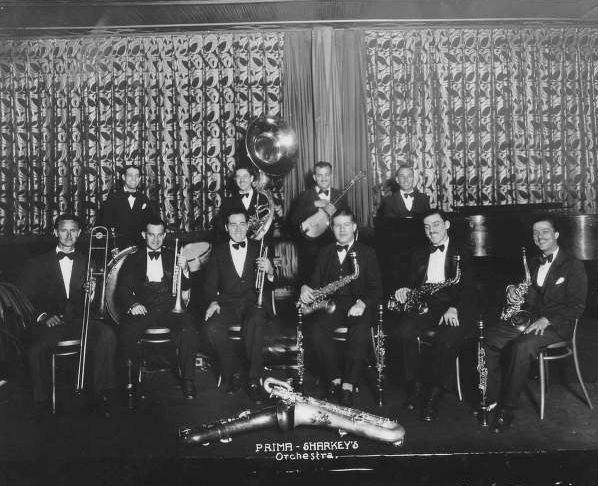
retiring from music in 1955. Pictured is the Prima-Skarkey Orchestra in 1930 at the at the Little
Club in New Orleans -- Front row: Charlie Hartmann (trombone), Sharkey Bonano (trumpet), Leon Prima (trumpet), Irving "Fazzola"
Prestnoptik (clarinet and sax), Dave Winstein (sax and clarinet), Nina Picone (sax); back row: Augie Schellang (drums), Louie
Mass
September1935 -- advertisement..."Opening Tonight -- Louis Prima and his New Orleans Five Orchestra Direct
from the Famous Door in New York at Prima's Shim-Sham Club for Five Days Only featuring the Kind of Music that made him the
Toast of Broadway -- Shim-Sham Review...Dimples Dalton, Princess of Blues...Shim-Shamettes, Beauty Chorus...Barron and Lynne"
1936 Louis wrote "Sing Sing Sing" (in the Grammy Hall of Fame) which became one of
the most popular songs of the swing era (big hit for Benny Goodman) Swing era "Jump, Jive and Wail"
1938 New Orleans City Guide -- Prima's Shim Sham Club , 229 Bourbon St., is open
1938 -- "Under New Management" as the Swing Club
small sign "Proudly Presents
2 Shows Featuring Hi-Class Entertainment" Larger sign "Formerly Prima's...Tantalizing Swing Music...A
New Low Price Policy...No Cover Charge...No Miniumum...Under New Management" Image Source: http://louisdl.louislibraries.org/u?/CLF,2348
"Bacciagaloop, Makes Love on the Stoop"
1950s with New Orleans saxophonist Sam Butera and the Witnesses (beginning
1954) and a 16 year old Keely Smith (later his fourth wife). Hits included "Just a Gigolo - I Ain't Got Nobody,"
"Buona Sera," "Black Magic," "Zooma, Zooma," "When You're Smilin',"
1967 voice of King Louis the oragnutan in Walt Disney's animated film The Jungle Book
Louis died in New Orleans August 24, 1978 -- brain tumor. buried in Metairie Cemetery -- tomb
statue of Gabriel, the trumpeter-angel. inscribed "When the end comes, I know, they'll all say 'just a gigolo' as life goes on without
me..." Louis Prima Street (ave?) During the 1990s Ian
Hardcastle, sole owner and shareholder of Bourbon Street Gospel and Blues, inc. and 227 Bourbon Street, Inc., owned the property
from 227 through 235 Bourbon Street and sublet it for use as a jazz club. By the turn of the century, Bourbon Street
Entertainmen operated Utopia music club at this location where lighted trees and fountatins grace the large courtyard.
The company also owned the Jazz Parlor (125 Bourbon Street), the Ragin'
Rooster (228 Bourbon Street), and partially owned Howl at the Moon (135 Bourbon). Building
later housed Boogie Woogie, Utopia and Rhythms music clubs and Jazz Gumbo gift shop and
an ATM machine 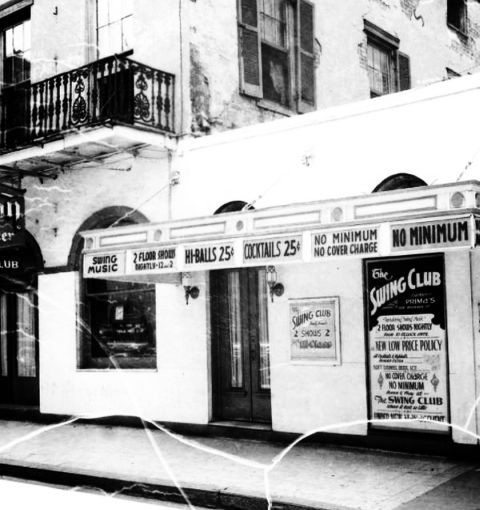
New York Times - Dec 8, 1910
New Orleans. Philadelphia, and Paris papers please -opy. LAKE., on Dec. (5, 1910.
Ann Augusta Lake, beloved mother of Louis N. Lake, in the 70th year of her ...
New York Times - Dec 9, 1910
8, 1910. members of this Society ore requested to attend the funeral services of their ...
AHcia Beatrice, wife of the late Thomas Kearney lof New Orleans. ...
NO CARLOAD OF BABIES FOR NEW ORLEANS
Atlanta Constitution Dec 18, 1910
Christian Science Monitor Dec 9, 1910
NEW ORLEANS--A monument to the memory of John James Audubon, the naturalist, who was a native
of Louisiana, among the oaks in Audubon park was unveiled ...
THROUGH TRAINS TO NEW ORLEANS. Los Angeles Times Dec 10, 1910
Souther Pacific Railroad has leted arrangements for additional gh passenger train service is Los
Angeles and New Oricans new Schedule will go into effect ...
JOY RIDE ENDS IN DEATH.
Los Angeles Times
Dec 14, 1910
Machine Plunges Into River Near New Orleans and One of Trio
of Occupants is Drowned. JOY RIDE ENDS IN DEATH. Machine Plunges Into River Near New Orleans and ...
NO BOUTS FOR NEW ORLEANS.
Los Angeles Times --
Dec 17, 1910
Acting Governor Orders Barry-Ross Go Stopped;Fight Set for Next SundayIs
Called Off;Chances for Pug Game DoNot Appear Bright. More on LATimes.com. Partners ..
THE CLAIMS OF NEW ORLEANS
Hartford Courant -Dec 17, 1910
In the extreme rivalry between the cities of New
Orleans and San Francisco for the honor of being chosen the city to have the world's exposition planned for ...IN
THE STRUGGLE FOR PANAMA EXPOSITION Arguments Meant For New England CLAIMS OF SOUTHERN CITY SET FORTH
NEW ORLEANS GETS GREAT RACES FOR MARDI GRAS
Atlanta Constitution Dec 18, 1910
Entry blanks are out for the New Orleans
Mardi Gras speed carnival, the third running of which will take place February 25, 26 and 27, 1911
GUNBOAT HORNET UNDER WATCH; HONDURAS REVOLUTION PENDING.
Los Angeles Times
-Dec 19, 1910
Federal Officials at New Orleans
Suspect Vessel Has Been Purchased to Aid in Revolt ... NEW ORLEANS, Dec. 18.--The for mer United States gunboat
Hornet, ... GUNBOAT HORNET UNDER WATCH; HONDURAS REVOLUTION
PENDING. Federal Officials at New Orleans Suspect Vessel Has Been Purchased to Aid in Revolt Fomented by Former President
Manuel Bonilla--Craft Ready to ClearPort at 10 O'clock Today. FORMER GUNBOAT TO SAIL AND JUNTA
MEMBERS ARE EXCITED
Dec 19, 1910 Chicago
Tribune Ad
Hotel Monteleone New Orleans'.
Hotel Monteeone Newest Hostelry ... Hotel Monteleone, New Orleans,
THIRD DEGREE CHARGED BY MAN
Los Angeles Times
Dec 20, 1910
NEW ORLEANS, Dec. 19.--[Exclu sive Dispatch.] Charging that
two. Federal attorneys Francis W. Bird of New York and Frank L. Garbarino of Mt. Holly, N.J., ...Witness
Asks Court to Hale in Prosecutors; Sensational Twist in Sugar Trust Case; Investigation to Halt New Orleans Trial.
THIRD DEGREE CHARGED BY MAN
Los Angeles Times Dec
20, 1910
Witness Asks Court to Hale in Prosecutors; Sensational Twist in Sugar Trust Case;
Investigation to Halt New Orleans Trial. NEW ORLEANS, Dec. 19. ..
FATAL END TO ANOTHER NEW ORLEANS JOY RIDE
Atlanta Constitution
- Dec 21, 1910
SENATE FAVORS SAN FRANCISCO. Los Angeles Times -Dec 25, 1910
Congress Will Decide Whether Northern City or New Orleans
Secures ... ""Congress will decide between New Orleans
and San Francisco as the place for holding the Panama-Pacific International Exposition between now and January 17 ......
DRAINING MARSHES OF NEW ORLEANS
Hartford Courant - Dec 27, 1910
New Orleans, Dec. 26.--The organization
this week of the Louisiana Development League marks the second great step in the transformation of 1000000 acres of ...TO
MAKE GARDENS AND FARMS OF THEM A Development League Organized TO TRANSFORM SURROUNDINGS OF CITY
AVIATORS ON GROUND FOR NEW ORLEANS MEET
Atlanta Constitution Dec 22, 1910
JOY-RIDING EPIDEMIC HITS NEW ORLEANS
Atlanta Constitution - Dec 23, 1910
During Past 24 Hours Many Machines Stolen---No Accidents
Reported
$1,000,000 ON IMPORTS LOST AT NEW ORLEANS
Atlanta Constitution Dec 30, 1910
Through False Weights and Improper Grading of Sugar
CHAMBERLAIN'S MOTHER DIES IN NEW ORLEANS
Atlanta Constitution Dec 31, 1910
December 31, 1910 - John B. Moisant Crasheshttp://louisdl.louislibraries.org/u?/JNT,241
Aviator John B. Moisant was selected to organize an international aviation tournament in New Orleans
in December of 1910 when flying was becoming a popular attraction.
On Dec. 30, piloting his Bleriot airplane,
Moisant competed in a five-mile race around a local track against a Packard automobile. A record for a mile was made
at 57 seconds and at a record height of 7,125 feet. In a series of automobile-airplane races, the car consistently defeated
the airplane piloted by John Moisant.
On Dec. 31, 1910, he left City Park and headed for a field near
Harahan. His intentions were to attempt to win a $4,000 prize that went with the Michelin Cup for sustained flight. The record
was 362.66 miles, and Moisant hoped to shatter this record.
As he flew his plane from City Park to the field
from which he was to begin his flight, his aircraft encountered a windshear. The plane fell, and without seatbelts holding
him in, Moisant fell from the aircraft and was killed. The area where he landed and died was named in his honor. John B. Moisant
became the 30th fatality among pioneer airmen throughout the world.
Moisant International Airport
(later named New Orleans International Airport and then Louis Armstraon International) was constructed and named for John
B. Moisant,
| Date: | 31-DEC-1910 | | Time: | | Type: | Blériot Monoplane | | Operator: | private | | Registration: | | C/n / msn: | | Fatalities: | Fatalities: 1 / Occupants: 1 | | Airplane damage: | Written off
(damaged beyond repair) | | Location: | Kenner near New Orleans, Louisiana
-  United States of America United States of America | | Phase: | Landing | | Nature: | Demo/Airshow/Display | | Departure airport: | | Destination airport: |
Narrative:
Crashed, while trying for the Michelin Cup, pilot John Moisant
World's Panama Exposition Company
In the early years of the twentieth century New Orleans, along with the larger region of the central United
States attempted to secure a second "World's Fair" for the Crescent City. The proposed exposition would draw
attention to the proximity of the local port, and the Mississippi River as a whole, to the new Panama Canal. Despite the best
efforts of local and regional promoters, though, the Panama Pacific International Exposition opend its doors during the year
1915 in San Francisco, not New Orleans. See photo at The http://nutrias.org/~nopl/monthly/august2005/august200512.htm
Louisiana Commemorative coin photo at http://www.expomedals.com/1915/
Kendall: The approaching completion of the Panama Canal gave rise, in 1907, to a movement to hold in New Orleans
a world's exposition which would fittingly celebrate that episode, fraught with so much significance to the commercial
future of the city. The movement was unsuccessful, the National Government committing itself eventually to an exposition at
San Francisco. The suggestion insofar as New Orleans was concerned was made by T. P. Thompson, in connection
with his work as a commissioner from Louisiana to the Jamestown Exposition. Mayor Behrman endorsed the idea, and on May 4,
1907, called a conference at the city hall, at which it was fully discussed. Four days later a committee was appointed to
develop the project, with T. P. Thompson as chairman and M. B. Trezevant as secretary. Although Governor
Sanders gave the plan his approval, the opening of the state gubernatorial campaign p562about this time made it seem wise to suspend the work, in order that the statewide exposition tax which it
would be necessary to levy if the project were to be successfully carried out, might not become a campaign issue and run the
risk of defeat. The election took place in November, and almost immediately thereafter occurred the financial disturbances
which, continuing through the following year, brought about a period of business depression in New Orleans as elsewhere
throughout the country. But in July, 1909, the exposition idea was revived; John Barrett of the Bureau of Latin American Republics
in Washington, was induced to visit New Orleans and deliver an address on trade relations with Latin America, with gratifying
results. In March, 1910, the city sent a delegation to Washington to lay the matter before President Taft, and in the following
month a public meeting was held in north of, at which plans were made to finance the preliminary work. On April 8 the
World's Panama Exposition Company was formed, which secured promises for funds aggregating nearly $8,000,000. But for
the determination of the national government to support San Francisco as the site of the exposition the project would
undoubtedly have been carried through to a brilliant success in New Orleans.8 History of New Orleans
by
John Kendall
published by The Lewis Publishing Company,
Chicago and New York, 1922
|
